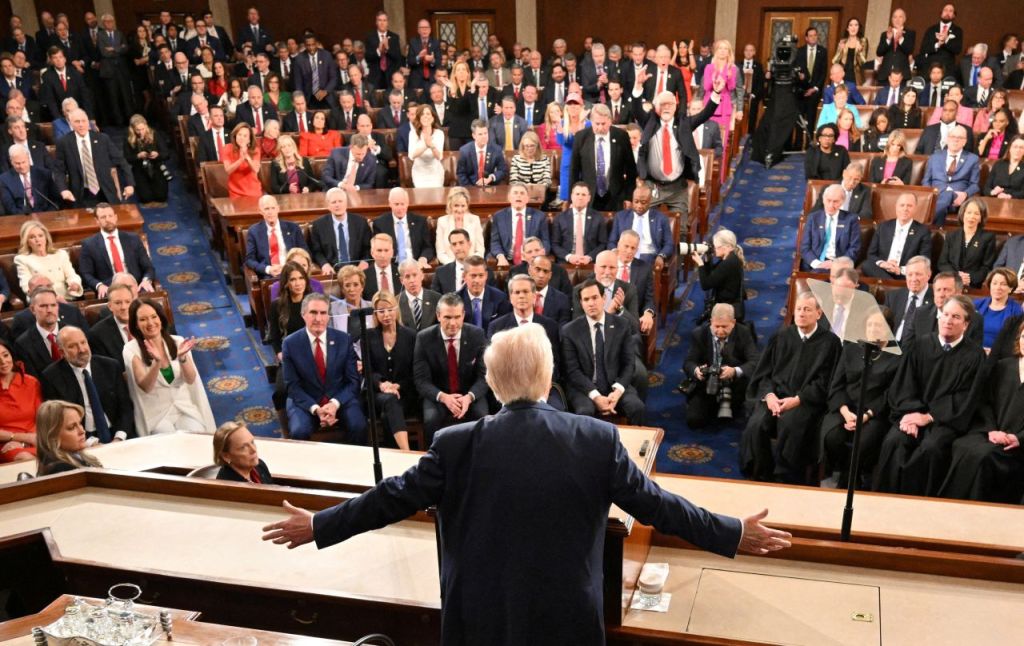
President Donald Trump’s addressed a joint session of Congress on March 4, 2025, this was his first speech to Congress since returning to office on January 20, 2025, and it occurred at the U.S. Capitol in Washington, D.C., presided over by House Speaker Mike Johnson and Vice President JD Vance. The address, delivered at 9 p.m. ET, lasted approximately 99 minutes, making it the longest such speech by a modern president, and it outlined Trump’s vision and actions during his first six weeks in office while setting the tone for his second term.
President Trump began his address by greeting Speaker Johnson, Vice President Vance, First Lady Melania Trump, and members of Congress, before declaring to the American people that “America is back.” He framed his speech around the theme of “The Renewal of the American Dream,” asserting that his administration had initiated a “Golden Age of America” since his inauguration. Trump emphasized that his first 43 days in office had seen more accomplishments than most administrations achieve in years, claiming, “We are just getting started.” He received applause and chants of “USA” from Republicans, though Democrats largely remained silent or protested.
Trump touted his election victory on November 5, 2024, as a historic mandate, noting he won all seven battleground states, the popular vote “by big numbers,” and 2,700 counties compared to his opponent’s 525. He cited a 27-point swing in public sentiment, claiming it was the largest ever recorded, with more Americans now believing the country was headed in the right direction. He also highlighted a 41-point jump in small business optimism, describing it as the largest one-month gain ever.
Early in the speech, Trump faced interruptions from Democrats. Representative Al Green (D-Texas) stood and shouted that Trump lacked a mandate, prompting Speaker Johnson to order Green escorted out of the chamber amid Republican chants of “USA.” Democrats held up signs with messages like “Musk Steals,” “Save Medicaid,” “Protect Veterans,” and “False,” while Representative Rashida Tlaib used a whiteboard to respond in real-time. Many Democratic women wore pink as a protest against Trump’s policies, which they argued harmed women and families. Trump taunted Democrats for their lack of applause, saying, “There is absolutely nothing I can say to make them happy or to make them stand or smile or applaud,” drawing smiles from Vance and Johnson.
A significant portion of the address focused on economic policies. Trump took credit for reorienting the nation’s economy, promising “dramatic and immediate relief” for working families. He blamed the Biden administration for an “economic catastrophe and inflation nightmare,” specifically citing high egg prices due to avian flu (though he did not mention the cause). To lower costs, he proposed investments in a natural gas pipeline in Alaska and expanding rare earth mineral production. Trump strongly advocated for his “reciprocal tariffs,” which began on March 4 with 25% tariffs on goods from Mexico and Canada and doubled 10% tariffs on China. He argued that other nations, such as India (over 100% auto tariffs), China (twice U.S. rates), and South Korea (four times higher), had long imposed higher tariffs on U.S. goods, justifying his policy as a means to level the playing field and revive American manufacturing. These tariffs, however, sparked fears of a trade war, with Canada, Mexico, and China announcing retaliatory measures.
Trump addressed immigration, emphasizing border security as a top priority. He shared the story of a 12-year-old girl killed by illegal immigrants, addressing her mother in the gallery and displaying an executive order renaming a wildlife refuge in her honor, which drew Republican applause. He called for Congress to fund “the largest deportation operation in American history,” surpassing even President Dwight Eisenhower’s efforts, and urged Speaker Johnson and Senate Leader John Thune to send him the funding quickly, promising to sign it “so fast you won’t even believe it.”
Trump highlighted his creation of the Department of Government Efficiency (DOGE), led by Elon Musk, who attended the speech and was personally thanked by the president. He claimed DOGE had uncovered “hundreds of billions” in fraud, though no detailed accounting was provided. Other domestic achievements included ending foreign aid, banning transgender athletes from school sports, and initiatives to reduce federal government size. He also promised to restore law and order, criticizing the “radical left” for undermining the justice system, and hinted at empowering police, possibly with greater immunity.
On foreign policy, Trump addressed his shift in U.S. stance toward global conflicts. He discussed his recent decision to freeze military aid to Ukraine, following a tense Oval Office meeting with Ukrainian President Volodymyr Zelenskyy on February 28, 2025, where he reportedly called Zelenskyy a “dictator” while praising Russia’s Vladimir Putin. Trump outlined plans to foster peace in Ukraine and the Middle East, including a controversial proposal for the U.S. to take ownership of Gaza and redevelop it—a drastic shift in policy with little detail provided. These remarks followed his broader campaign rhetoric admiring authoritarian leaders like Putin and China’s Xi Jinping.
The speech featured theatrical moments, such as Trump holding up the wildlife refuge order. Guests included Stephanie Diller, widow of a slain NYPD officer; Marc Fogel, a teacher recently freed from Russia, with his 95-year-old mother; and relatives of Corey Comperatore, killed during an assassination attempt on Trump in 2024. Some Democrats invited fired federal workers and those affected by budget cuts to highlight Trump’s policies. Secretary of Veterans Affairs Doug Collins was the designated survivor, absent from the
At 99 minutes, the speech surpassed Bill Clinton’s 89-minute address in 2000 as the longest modern joint session speech, slowed by interruptions and applause. Republicans cheered Trump’s vision, while Democrats, including Senator Elizabeth Warren, who called it “one lie heaped on another,” expressed strong dissent. Senator Elissa Slotkin (D-Mich.) delivered the Democratic rebuttal, focusing on economic concerns and criticizing Trump’s ties to Musk.
Trump concluded by reiterating his campaign promises to lower prices, secure the border, and reshape America’s global role, framing his rapid actions as fulfilling an electoral mandate. He positioned his administration as ushering in an unprecedented era of American success, despite a divided Congress and nation—Gallup polls showed his approval rating at 47% upon taking office, with majorities disapproving of his handling of six key issues. The address underscored his fast-paced approach, with dozens of executive orders already signed, and set the stage for legislative battles over funding his agenda, including a looming government shutdown deadline on March 14, 2025.

Leave a comment