Category: Home

  • The Language of Rain: What Raindrops ‘Say’ About the Sky, Decoded for Beginners

    The Language of Rain: What Raindrops ‘Say’ About the Sky, Decoded for Beginners

    By EBMOmniScope

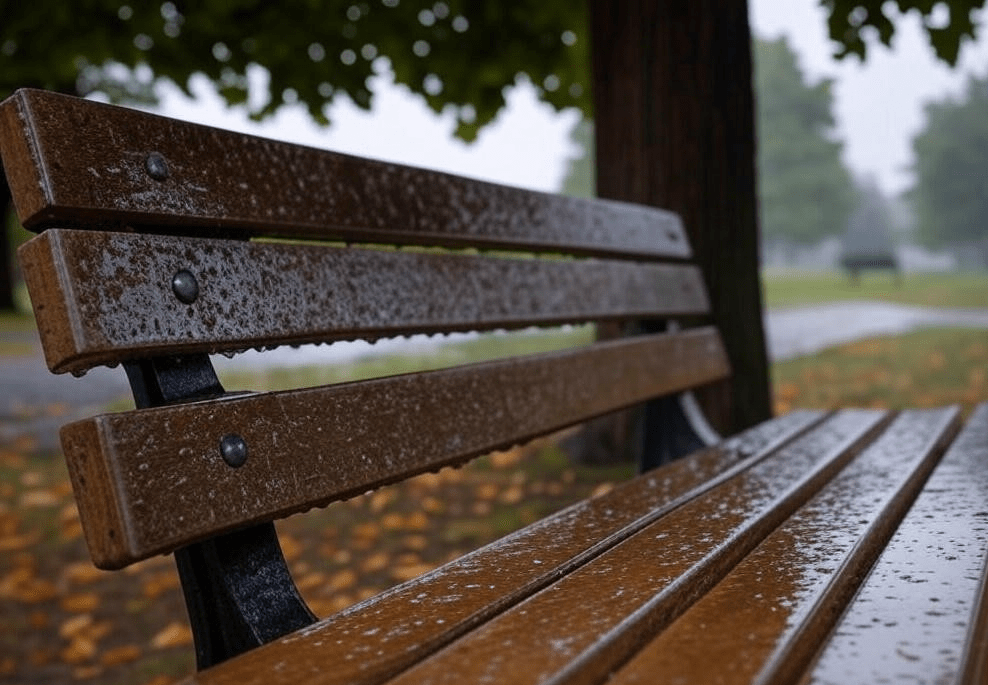
    Rain’s got a voice. It taps on your roof, whispers in the trees, or roars in a storm—and it’s not just noise. Every drop’s a message from the sky, spilling secrets about where it came from and what’s brewing up there. Is it a gentle hello or a wild warning? You don’t need a PhD to crack it—just curiosity. Let’s decode the language of rain and hear what those wet little messengers are saying.

    The Drop’s Journey

    Raindrops start high—way high. Water vapor floats up, cools, and clumps into clouds. When those clumps get heavy, gravity says, “Down you go!” But not all drops are the same. Tiny ones drizzle from low, gray stratus clouds—think a soft mumble. Big, fat ones plummet from towering cumulonimbus, shouting with thunder. Size matters: a 2020 study clocked drizzle at 0.5 millimeters, storm drops at 5 millimeters—ten times beefier.

    Their sound’s a clue too. Light rain patters like a shy knock; heavy rain drums like a rock concert. That’s speed and mass hitting surfaces—physics turning water into a beat.

    What’s in the Message?

    Rain’s chatty about the weather. A steady drip says, “Clouds are full, but chill.” Sudden gushes scream, “Storm’s here—buckle up!” Scientists listen too. Doppler radar tracks how fast drops fall, mapping wind and rain strength. A 2018 report showed big drops mean updrafts—air punching up, feeding a tempest. Small ones? The sky’s winding down.

    Even the smell talks. That fresh “rain scent”? It’s bacteria spores kicked up by drops—geosmin, earthy and alive. Your nose catches the sky’s mood before your eyes do.

    The Past in a Puddle

    Rain’s a historian. Each drop grabs stuff on the way down—pollen, dust, smoke. A 2019 study found rain in Colorado carried Sahara sand—3,000 miles away! Old rain, trapped in ice cores, spills ancient tales: volcanic ash from 79 CE (hello, Pompeii) or carbon from coal fires. It’s like the sky’s texting us its diary.

    Acid rain? That’s a grumpier note—sulfur from factories turning drops sour. It’s less common now, but it’s the sky scolding us for messy habits.

    Hearing the Rain

    Rain’s language shifts. A sprinkle invites you out; a downpour dares you to stay in. Next time it falls, listen. Is it chatting, singing, or yelling? It’s not just water—it’s the sky talking, and you’re fluent if you try.

  • Dancing with Dust: The Surprising Journey of Dust Particles in Your Home and Beyond

    Dancing with Dust: The Surprising Journey of Dust Particles in Your Home and Beyond

    By EBMOmniScope

    Dust. It’s everywhere—on shelves, in sunbeams, up your nose. You swipe it away, but it’s back like a boomerang. Ever wonder where it comes from or why it floats like that? Dust isn’t just dirt—it’s a tiny traveler with a big story, from your couch to the cosmos. Let’s follow its dance and see what this fluffy nuisance is really up to.

    Dust’s DNA

    Dust’s a mishmash. Skin flakes (yep, you shed 30,000 a day), pet hair, pollen, fabric fuzz—your home’s a dust factory. Outside, it’s soil, smoke, even ocean salt blown inland. A 2021 study found a single speck can hold bits from 1,000 miles away. It’s not local—it’s global.

    And it’s old. Some dust is meteorite crumbs—space rocks burning up, sprinkling Earth. You’re breathing stardust, literally.

    The Floating Trick

    Why’s dust so drifty? Size and weight. Most particles are 1-100 microns—smaller than a hair’s width. They’re light enough to ride air currents, stirred by your footsteps or a cracked window. Brownian motion—random molecular bumps—keeps them jiggling too. It’s a dance party you can’t see.

    Sunbeams show it off. Light scatters off dust, making those golden rays. Without it, your room’s less magical (but cleaner).

    The Journey Beyond

    Dust doesn’t stay put. Wind hauls it across continents—Sahara sand dusts Europe yearly. It seeds clouds—water sticks to particles, sparking rain. A 2019 study says dust from Africa feeds the Amazon, dropping phosphorus for trees. Your sneeze might’ve started in Morocco.

    Indoors, it’s a time capsule. Dust traps pollen from last spring, crumbs from last week. Scientists sift it to track climate or pollution—your bookshelf’s a history book.

    Dust’s Big Moves

    It’s small but mighty. Dust fertilized oceans in the Ice Age, growing plankton that cooled the planet. Today, it carries pollutants—or fights them, scrubbing air in tiny ways. Next time you dust, you’re not just cleaning—you’re remixing Earth’s story.

  • The Great Sock Mystery: Where Do Lost Socks Go, and What Physics Might Explain It?

    The Great Sock Mystery: Where Do Lost Socks Go, and What Physics Might Explain It?

    By EBMOmniScope

    Lost socks. The laundry curse. You toss two in the washer, but only one comes out—where’d the other go? It’s a universal groaner, a riddle that’s spawned memes, rants, and wild theories. Is it gremlins? A sock Bermuda Triangle? Let’s sleuth it out with a grin and some science—because physics might just crack the case of the vanishing threads.

    The Sock Stats

    It’s real. A 2016 Samsung survey (yep, they cared) found Brits lose 1.3 socks a month—15 a year. Over a lifetime, that’s 1,200 socks per person. Multiply by millions, and we’re drowning in missing mates. They’re not in drawers or under beds—so where?

    The Washer Vortex

    Prime suspect: your washing machine. It’s a sock-eating beast. Small items like socks can slip into the drum’s gaps—those rubber seals or tiny holes. A 2018 study by appliance folks found socks wedged in there, soggy and forgotten. Physics backs it: water swirls fast (centrifugal force), flinging light stuff like socks to the edges, where they sneak out.

    Dryers join the crime. Lint traps snag them, or they static-cling to sheets, tumbling into oblivion. Ever found a sock inside a pant leg? That’s physics too—electrostatic attraction gluing them together.

    The Chaos Factor

    Entropy’s in on it—nature’s love for disorder. Socks don’t pair up neatly; they scatter. One study says small, stretchy items are chaos magnets in a spin cycle—more likely to drift than a stiff towel. Add a crowded load, and it’s sock roulette.

    And don’t rule out the floor. Socks fall behind machines or get kicked under furniture—gravity’s quiet assist. They’re not “lost” lost—just hiding where you won’t look.

    The Fun Theories

    Science aside, we love a laugh. Some say dryers are sock portals to Narnia. Others blame “sock gnomes” (thanks, South Park). A 2020 poll found 30% of people half-believe washers eat them. No proof, but it’s more fun than “stuck in the gasket.”

    The Sock Solution

    Where do they go? Washer guts, dryer tricks, or plain old chaos. Physics says they’re not teleporting—just slipping through cracks we miss. Next load, count ‘em in, count ‘em out. You might solve the mystery—or at least save a sock.

  • Why Your Nose Knows: The Weird Science of Smell and Its Hidden Superpowers

    Why Your Nose Knows: The Weird Science of Smell and Its Hidden Superpowers

    By EBMOmniScope

    Sniff. What’s that? Fresh coffee? Wet dog? Your nose just clocked it before your eyes even tried. Smell’s the underdog of senses—quiet, weird, and way more powerful than we give it credit for. It can zap you back to grandma’s kitchen or warn you the milk’s gone rogue. How does it pull that off? Why’s it so sneaky-good? Let’s nose-dive into the science of scent and uncover its hidden superpowers.

    The Smell Machine

    Your nose is a marvel. Up there, behind your nostrils, sits a patch of tissue the size of a postage stamp—your olfactory epithelium. It’s packed with 10 million receptor cells, each sniffing for specific molecules. Inhale, and odor particles—say, from a pizza—float in, stick to those cells, and ping your brain: “Pepperoni alert!” It’s fast—faster than sight or sound—and runs 24/7.

    Humans can detect over a trillion smells, a 2014 study found. Not just “rose” or “rain”—your nose picks up shades of scents, like a painter mixing colors. Dogs beat us (they’ve got 300 million receptors), but we’re no slouches. It’s a superpower we barely notice.

    The Brain’s Backdoor

    Smell’s got VIP access. Unlike sight or touch, which detour through your brain’s logic hub, scent bolts straight to the amygdala and hippocampus—emotion and memory central. One whiff of sunscreen, and you’re 10, building sandcastles. That’s why smells hit harder than photos. A 2020 study showed people recall scents from childhood better than sights—your nose is a time machine.

    It’s primal too. Our ancestors sniffed for food, mates, danger. Today, it still warns you—smoke, gas, that funky trash. Your nose doesn’t mess around; it’s your quiet bodyguard.

    The Weird Stuff

    Smell’s full of quirks. Ever notice rain “smells” before it falls? That’s petrichor—oils from plants and soil kicked up by wind. Your nose catches it early, like a weather app with flair. Or how about pheromones? We don’t flirt like moths, but a 2017 study hints sweat might subtly sway who we vibe with. It’s not love potion—it’s sneakier.

    And get this: you smell in stereo. Two nostrils, slightly offset, give your brain a 3D scent map. Sniff a flower, and you can tell if it’s left or right. Subtle, but slick.

    Superpower Unlocked

    Your nose does more than sniff. It tastes—half your flavor’s from smell (pinch your nose, and food’s blah). It heals—aromatherapy’s legit; lavender cuts stress, per a 2019 study. It even IDs people—babies know mom’s scent days after birth. You’ve got a superpower up there, and it’s been flexing since day one.

    Next time you catch a whiff, don’t shrug it off. Your nose knows—more than you think.

  • The Secret Lives of Shadows: How Shadows Shape Our World, from Sundials to Spooky Tales

    The Secret Lives of Shadows: How Shadows Shape Our World, from Sundials to Spooky Tales

    By EBMOmniScope

    Shadows are sneaky. They follow you around, stretch and shrink without a word, and vanish when the lights go out. We barely notice them, but these silent stalkers have been shaping our world forever—from telling time to fueling ghost stories. What’s their deal? How do they work their quiet magic? Let’s step into the shade and uncover the secret lives of shadows—part science, part wonder, all cool.

    Shadows 101: The Basics

    A shadow’s simple: light hits something, gets blocked, and leaves a dark patch. Sun, lamp, flashlight—same trick. The sharper the light, the crisper the shadow. Ever notice how moonlight makes fuzzier edges? That’s because the moon’s light scatters more. It’s physics, but it feels like art—your silhouette dancing on the wall, a tree’s outline swaying in the breeze.

    Shadows shift too. Morning sun stretches them long and lean; noon squashes them short. It’s the Earth spinning, tilting the light’s angle. Ancient folks clocked this—literally. Sundials, those stone timekeepers, used shadows to mark hours as far back as 1500 BCE in Egypt. No batteries, just the sun and a stick. Shadows weren’t just there—they were useful.

    Timekeepers and Tricksters

    Sundials ruled for centuries. Romans built giant ones, like the 100-foot Solarium Augusti, to track days and seasons. Shadows didn’t just tell time—they mapped the cosmos. Sailors used them to navigate, farmers to plant. Even today, a stick in the dirt can tell you when lunch is if you know the trick.

    But shadows have a wild side. They twist reality. Ever seen your shadow look like a monster on a dark street? That’s light bending around you, stretching the truth. Old tales leaned into this—think Peter Pan’s runaway shadow or Plato’s cave, where shadows were all people knew of the world. They’re not just dark spots; they’re storytellers.

    The Science of Spookiness

    Why do shadows creep us out? Blame your brain. In dim light, it fills gaps—turning a coat rack’s shadow into a lurking figure. It’s a survival hack: better to jump at nothing than miss a real threat. Add a flickering candle, and shadows dance, feeding campfire tales of ghosts and ghouls. Science says it’s just light and angles, but try telling that to your pounding heart at 2 a.m.

    Shadows play tricks in nature too. During a solar eclipse, the moon’s shadow races across Earth at 1,000 miles an hour, dropping day into night. “Shadow bands”—wavy lines—ripple on the ground as air bends the light. It’s eerie, like the planet’s holding its breath. No wonder ancient folks thought the sky was mad.

    Shadows in the Spotlight

    Artists love shadows. Painters like Caravaggio used them to pop faces out of gloom—chiaroscuro, they call it. Movies lean hard on them—think noir detectives or horror flicks where the shadow moves before the monster. Even shadow puppets, big in Asia for centuries, turn a blank wall into a stage. Shadows don’t just sit there—they perform.

    Today, they’re high-tech too. Shadow mapping in video games makes 3D worlds feel real—every rock casting its shade. Architects use shadow studies to design buildings that catch light just right. Shadows aren’t old news; they’re still shaping how we see.

    The Quiet Power

    Shadows don’t shout, but they matter. They’ve timed our days, spooked our nights, and framed our art. Next time you spot yours trailing behind, give it a nod. It’s been around longer than you, telling tales and keeping secrets—one dark, stretchy step at a time.

  • The Clock That Runs Backward: Could Time Really Flow in Reverse Somewhere?

    The Clock That Runs Backward: Could Time Really Flow in Reverse Somewhere?

    By EBMOmniScope

    Time ticks forward—breakfast, lunch, dinner, repeat. But what if it didn’t? What if somewhere, a clock spun backward—yesterday after tomorrow, eggs un-breaking, you getting younger? It’s a brain-bender straight out of sci-fi, but physics says it’s not totally nuts. Could time reverse? Is it already doing it somewhere weird—like a black hole or a quirky particle? Let’s wind the clock back (or forward?) and explore the wild idea of time going rogue.

    Time’s One-Way Street

    We live by the “arrow of time.” Stuff happens—ice melts, coffee cools, you age. It’s entropy, the universe’s rule that chaos grows. Drop a glass, it shatters. Never seen shards jump back into a cup, right? That’s thermodynamics talking—forward’s the only way. Or is it?

    Physics gets tricky. Most laws—like gravity or motion—don’t care about time’s direction. Roll a ball left or right, the math works both ways. So why’s time stuck going one way? Some say it’s just how we see it—our brains stitching cause before effect.

    The Backward Possibilities

    Enter quantum weirdness. Tiny particles don’t always play by our rules. In 2019, scientists at MIT “reversed” time for a few atoms using a quantum computer—sort of. They tweaked energy states to mimic a rewind. It’s not a DeLorean, but it hints time’s flexible down there.

    Black holes might flip it too. Near one, time slows—thanks, Einstein. Inside? Some theories say it could loop or reverse, with effects pre-dating causes. No one’s popped in to check, but the math’s tantalizing.

    Cosmic Clues

    The Big Bang set time’s arrow, but what if the universe bounces? Some cosmologists think it could collapse and restart—maybe backward. A 2020 paper suggested “anti-universes” where time runs the other way, balancing ours. Wild? Yep. Possible? Kinda.

    Even particles like positrons act like electrons moving back in time. It’s a theory trick, but it works. Maybe time’s not as stiff as we think.

    Could We Feel It?

    If time reversed, would you notice? Maybe not—your brain might flip too, making “backward” feel normal. A 2018 thought experiment says we’d need an outside view to spot it. For now, our clocks tick on, but somewhere— Ascendant might be winding them back.

    So, could time flow backward? In tiny corners or cosmic extremes, maybe. It’s a mind-twist that keeps physicists up at night—and us dreaming of undone spills.

  • The Hidden Power of Puddles: What Tiny Pools Reveal About Earth’s Big Secrets

    The Hidden Power of Puddles: What Tiny Pools Reveal About Earth’s Big Secrets

    By EBMOmniScope

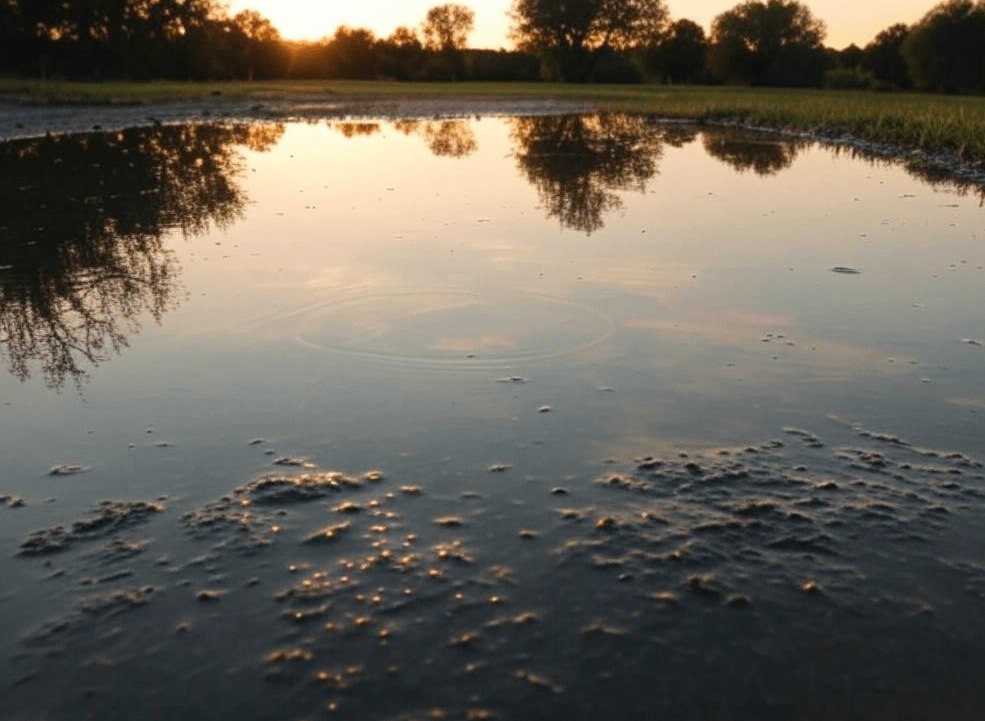
    Puddles. They’re the underdogs of nature—splashed under boots, ignored by umbrellas. But don’t sleep on them. These mini-lakes are more than wet annoyances; they’re tiny mirrors reflecting Earth’s big stories. From ancient climates to modern pollution, puddles hold clues scientists drool over. How can something so small spill so much tea? Let’s splash in and find out what these soggy spots are whispering about our planet.

    Puddles as Time Capsules

    Every puddle’s a snapshot. Rain falls, pools up, and grabs whatever’s around—dust, pollen, bugs. Dry out, and it leaves a crusty archive. Geologists love this. In dry places like Australia’s outback, old puddle beds show what grew there 10,000 years ago—grasses or trees?—hinting at wetter times. Fossilized puddles from the Jurassic even trap dino footprints, proving T-Rex splashed too.

    Water’s a magnet for evidence. A 2019 study in Antarctica found puddle sediments with ancient algae, showing when ice melted long ago. Puddles don’t just sit there—they snitch on the past.

    The Pollution Detectives

    Today’s puddles tattle on us. Rain washes car oil, plastic bits, and smoke into them. Scientists scoop samples and find microplastics—teeny trash bits—in puddles from cities to forests. A 2021 UK study clocked thousands of particles per liter. That’s Earth’s mess, pooled up for us to see. Heavy metals like lead show up too, tracing back to factories or old paint. Puddles are like nature’s lie detectors, calling out our dirty habits.

    But it’s not all doom. Some puddles host life—bacteria that munch pollutants, cleaning the mess. They’re tiny heroes in a soggy world.

    Weather’s Little Helpers

    Puddles spill weather secrets too. How fast they dry? That’s air temp and humidity talking. Big puddles after a drizzle might mean the ground’s soaked—clueing us into floods or droughts. In cities, puddles map drainage flops—ever notice that one spot that’s always wet? It’s the pavement’s cry for help.

    Farmers watch them too. A puddle sticking around too long screams “soil’s clogged”—time to rethink crops. They’re small, but they’re loud if you listen.

    The Puddle Power

    Puddles don’t judge—they reflect. They’ve seen ice ages, industrial booms, and your muddy sneakers. Next time you step over one, pause. It’s not just water—it’s a story, pooling up Earth’s wins, losses, and everything in between. Small? Sure. Mighty? You bet.

  • The Ice Cream Conspiracy: How Frozen Treats Secretly Changed History

    The Ice Cream Conspiracy: How Frozen Treats Secretly Changed History

    By EBMOmniScope

    Ice cream. It’s cold, creamy, and screams summer—but it’s also a sneaky history-maker. Behind the sprinkles and waffle cones lies a tale of emperors, inventors, and some wild twists that shaped the world. Did ice cream start a revolution? Boost a war effort? Seduce a king? Maybe not directly, but its chilly fingerprints are all over the past. Let’s scoop into the secret life of this frozen treat and see how it quietly churned its way into history.

    The Ancient Chill

    Ice cream’s roots are old—think 200 BCE old. Persian nobles mixed snow with fruit juice in underground pits called yakhchals. It was a flex—only the rich had ice in a desert. Fast forward to China’s Tang Dynasty (600s CE), and they’re blending buffalo milk with camphor (yep, mothball stuff) and freezing it. Tasty? Maybe not. Exclusive? Definitely. These treats weren’t just snacks—they were power moves, showing off wealth and tech.

    Then Marco Polo (maybe) brought the idea west in the 1200s. Legend says he swiped a recipe from the Mongols—milk frozen on horseback. Historians argue over that one, but by the Renaissance, Italy’s Medici family was obsessed. Catherine de’ Medici hauled her gelato chefs to France in 1533, dazzling the court. Ice cream wasn’t just dessert—it was diplomacy, a sweet bribe to win allies.

    The Royal Scoop

    Cut to England, 1660s. King Charles II gets a taste at a banquet—pineapple ice, a total luxury. Only the elite could afford ice hauled from mountains and stored in “ice houses.” It’s said he banned commoners from making it—true or not, it became a royal obsession. Across the pond, Thomas Jefferson scribbled an ice cream recipe in 1780s Virginia, serving it at fancy dinners. George Washington blew $200 (big bucks then) on ice cream in one summer. For these guys, it was status—proof you could tame nature and serve it cold.

    But here’s the twist: ice cream leaked to the masses. In 1843, Nancy Johnson patented a hand-crank freezer—suddenly, anyone with milk and ice could churn some. By the 1900s, street vendors were slinging cones. The elite lost their monopoly, and ice cream went rogue.

    War and Waffle Cones

    Fast forward to World War II. The U.S. Navy built ice cream barges—floating factories pumping out gallons for troops. It wasn’t just a treat; it was morale. Soldiers got a taste of home while fighting in the Pacific. Mussolini banned it in Italy to seem tough, but the Allies? They leaned in. Ice cream became a symbol—freedom in a scoop.

    Back home, the 1904 St. Louis World’s Fair birthed the waffle cone by accident. An ice cream guy ran out of dishes, so a nearby waffle maker rolled his goods into cones. Boom—portable dessert. It spread like wildfire, changing how we eat on the go. Ice cream wasn’t just chilling—it was innovating.

    The Cold Conspiracy

    Here’s the juicy bit: ice cream’s tied to big moments. Dolly Madison served it at the White House in 1813, charming guests during tense talks—some say it softened deals. Prohibition in the 1920s? Bars turned into ice cream parlors, keeping the party alive. And in the Cold War, the U.S. bragged about its ice cream production—capitalism’s sweet edge over the Soviets.

    It’s not a grand plot, but ice cream’s knack for popping up at turning points—wars, inventions, social shifts—makes you wonder. Did it nudge history, or just tag along? Either way, it’s got a legacy stickier than melted fudge.

    The Modern Melt Today, ice cream’s a global king—$80 billion a year. It’s still flexing, too. Vegan scoops, wild flavors (bacon, anyone?), and liquid-nitrogen tricks keep it fresh. But its real power? Nostalgia. One lick, and you’re a kid again. That’s history in every bite—quiet, cold, and delicious

  • Why Yawns Are Contagious: The Bizarre Biology of a Sleepy Chain Reaction

    Why Yawns Are Contagious: The Bizarre Biology of a Sleepy Chain Reaction

    By EBMOmniscope

    Yawn with me. Go on—open wide, let it out. Feel that stretch? Now picture this: you’re in a quiet room, someone yawns, and suddenly you’re doing it too. Then the guy next to you joins in, and it’s a sleepy domino effect. Why does that happen? Yawns aren’t germs, so why do they spread like a cold? It’s one of life’s little mysteries—half annoying, half hilarious—and the answer’s a wild mix of brain tricks, social glue, and maybe even ancient survival hacks. Let’s dig into the science of the yawn and why it’s the weirdest chain reaction you can’t resist.

    The Yawn Basics

    First, what is a yawn? It’s your mouth gaping, lungs gulping air, and sometimes a squeaky sound sneaking out. Scientists say it cools your brain—literally. Your head’s a hot little engine, and yawning’s like cracking a window when it overheats. A 2014 study found yawns peak when your skull’s temp climbs, like after a long day or a stuffy room. It’s why you yawn when you’re tired or bored—your brain’s begging for a breeze.

    But here’s the kicker: yawning’s not just a solo act. See a yawn, hear a yawn, even think about yawning (admit it, you’re tempted now), and boom—you’re hooked. It’s contagious, and not just for humans. Dogs catch it from us. Chimps pass it around. Even parrots might join the party. So, what’s wiring us to copycat?

    The Empathy Connection

    One big clue? Your brain’s social side. Scientists point to mirror neurons—tiny cells that fire when you do something or see someone else do it. Watch a friend grab a snack, and your brain lights up like you’re munching too. Same with yawning. A 2003 study hooked people to brain scanners and showed them yawn videos. Guess what? The empathy zones—parts tied to understanding others—went wild. The more you care about someone, the more likely you’ll catch their yawn. It’s why your bestie’s yawn gets you, but a stranger’s might not.

    Kids under four don’t do it much—they’re still building that empathy muscle. Same with folks on the autism spectrum, who often process social cues differently. It’s not a rule, but it hints yawning’s a “me too” signal, a way to sync up with your crew.

    The Pack Instinct

    Rewind a few million years. Our ancestors lived in groups—safety in numbers. Yawning might’ve been a silent memo: “I’m sleepy, let’s rest.” If one caveman yawned and the others followed, the whole gang could nap together, staying alert for saber-tooth tigers. A 2017 study on baboons backs this up—they yawn more when their troop’s winding down. It’s like nature’s group chat, keeping everyone on the same page.

    Or maybe it’s a vibe check. Lions yawn to signal a hunt’s over—time to chill. For us, a shared yawn might say, “We’re cool, no stress here.” It’s less about words, more about feeling connected. Next time you yawn at a meeting, you’re basically primal-bonding with your coworkers. Weird flex, but okay.

    The Mystery Lingers

    Not everyone’s sold, though. Some say it’s simpler—yawning’s just catchy, like a laugh or a sneeze. Your brain sees a trigger and hits copy-paste, no deep meaning required. Others argue it’s about temperature still—if your pal yawns to cool off, you might need to as well in the same hot cave (or office). A 2011 experiment tested this: people yawned less with cold packs on their heads. So maybe it’s practical, not profound.

    And get this—it’s not foolproof. About half of us catch yawns from watching them. The other half? Immune, smirking at the rest of us mid-gape. Why the split? No one’s cracked it yet. Maybe it’s personality, maybe it’s luck. Science is still yawning over the details.

    The Yawn’s Sneaky Power

    Here’s the fun part: yawning’s a ninja. You don’t decide to catch it—it just happens. Try resisting next time someone lets one rip nearby. Bet you can’t. It’s a reflex with swagger, sneaking past your willpower. And it’s universal—cross cultures, species, even time. Shakespeare’s characters yawned. Dinosaurs probably did too (imagine a T-Rex mid-roar). It’s the oldest trick in the book, and we’re all suckers for it.

    So why’s it contagious? It’s your brain cooling off, your empathy flexing, and maybe your inner pack animal saying hi—all rolled into one stretchy, sleepy moment. Next time you spark a yawn chain, don’t blush—own it. You’re a walking biology lesson, and the room’s your lab.

  • The Ants’ Internet: How Ant Colonies ‘Network’ Like a Living Web

    The Ants’ Internet: How Ant Colonies ‘Network’ Like a Living Web

    By EBMOmniScope

    Ants. Tiny, relentless, and everywhere. You’ve probably seen them marching in a line, hauling crumbs bigger than their heads, or turning your picnic into their buffet. They seem simple, right? Just little bugs doing bug things. But zoom in, and you’ll find something wild: ant colonies don’t just work together—they network. Like a living, breathing internet, they share info, solve problems, and adapt in ways that make our Wi-Fi look sluggish. How do these six-legged wonders pull it off? What’s the secret behind their tiny, chaotic empire? Let’s crawl into the ant world and uncover a system so smart it’s almost sci-fi.

    The Colony: A Super-Brain with No Boss

    First off, ants don’t have a CEO. There’s no “head ant” barking orders from a tiny throne. The queen? She’s just an egg-laying machine, not a mastermind. Yet somehow, a colony of thousands—or even millions—acts like one big brain. They find food, build tunnels, fight enemies, and even farm fungi, all without a playbook. Scientists call this a “superorganism,” where the group’s smarts come from everyone pitching in. It’s teamwork on steroids.

    How do they sync up? The answer’s in their version of the internet: a mix of chemical signals, touch, and some seriously clever instincts. Think of it like data packets zipping through a network, only instead of cables, it’s pheromones and antennae. Each ant’s a node, sending and receiving info, building a web that’s alive and always updating. No Zoom calls needed—just pure, organic connection.

    Pheromones: The Ants’ Wi-Fi

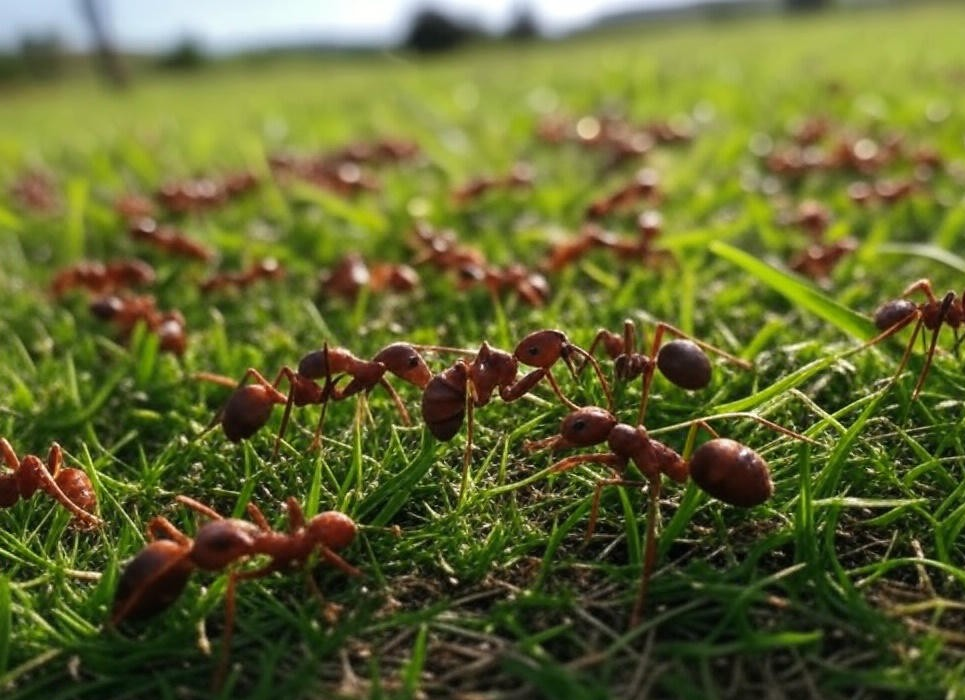
    The backbone of this network is smell. Ants “talk” with pheromones—chemicals they drop like digital breadcrumbs. When a scout finds food, she lays a scent trail back to the nest, shouting, “Jackpot over here!” Other ants sniff it out, follow the path, and add their own pheromones to strengthen the signal. The more ants, the stronger the trail, like a trending hashtag going viral. If the food runs out, the scent fades, and the ants move on. It’s a self-updating system—no IT guy required.

    But it’s not just one smell. Ants have a whole chemical vocabulary. One pheromone might mean “danger,” another “dig here,” and a third “feed the babies.” Researchers have found some species, like Argentine ants, use dozens of these signals. It’s like they’ve got emojis for every mood, and every ant’s tuned in, sniffing the air for the latest update.

    Traffic Jams and Smart Routing

    Ever watch ants march in a perfect line? That’s their network in action. They’re not just following blindly—they’re optimizing. In the 1990s, scientists like Deborah Gordon studied how harvester ants adjust their paths. If too many crowd one route, some peel off to find a shortcut, laying new trails. It’s like Google Maps rerouting you around a jam, but with no satellites—just instinct and teamwork.

    This isn’t random. Math geeks love ants because their patterns mimic something called “ant colony optimization,” a computer algorithm inspired by these critters. It’s used to solve real-world problems, like finding the fastest delivery routes or untangling internet traffic. Ants figured it out first, though—millions of years before we did. Their network doesn’t crash; it adapts.

    The Hive Mind Goes Viral

    Here’s where it gets freaky: ants don’t just share directions—they share ideas. Take leafcutter ants. They don’t eat the leaves they snip—they grow fungus with them, like tiny farmers. How’d they learn that? No one taught them. The colony “knows” because the network passes it down. Young ants watch, smell, and copy, keeping the system humming. It’s like a living Wikipedia, edited by every ant who’s ever hauled a leaf.

    Or consider Argentine ants. They’ve built a global “supercolony” stretching from Spain to Japan. Millions of nests, billions of ants, all recognizing each other by scent. If two groups meet, they don’t fight—they link up, sharing resources like nodes on a massive server. It’s a network so big it rivals human cities, and it’s all run by bugs smaller than your pinky nail.

    When the Network Fights Back

    Ants don’t mess around when their web’s threatened. Army ants, for example, turn their network into a war machine. They swarm in waves, guided by pheromone trails, taking down prey 100 times their size. Their “data” flows fast—scouts report, soldiers move, and the colony eats. It’s brutal but brilliant, like a DDoS attack with mandibles.

    Even cooler? Some ants use their network to build. Weaver ants stitch leaves into nests using silk from their larvae, passing the kids around like tools. Each ant knows its job—pull here, glue there—because the network tells them. It’s construction by consensus, and the result’s a fortress hanging in a tree. Try that, Silicon Valley.

    Why It’s Smarter Than Us (Sometimes)

    Our internet’s fast, sure, but it’s fragile. One cut cable, one power outage, and we’re toast. Ants? Their network’s decentralized—no single point of failure. If a flood wipes out half the colony, the rest regroup, rebuild, and keep going. It’s not about one ant; it’s about the system. In 2011, researchers at Stanford found that ant trails recover from disruptions faster than human traffic grids. Next time you’re stuck on the highway, blame it on us not being ant-enough.

    And get this: ants don’t overthink. We humans debate, plan, and second-guess. Ants act. Their network’s simple rules—follow the scent, help the team—let them solve complex problems without a meeting. Scientists call it “emergent behavior”: big results from small steps. It’s why they can raid your kitchen before you even notice the spill.

    What We’re Stealing from the Ants

    Humans are obsessed with this. Engineers study ant networks to design better robots—swarms that explore Mars or clean up oil spills, talking to each other like ants do. Computer scientists tweak their algorithms for everything from logistics to AI. Even architects look at ant tunnels for ideas on ventilation or crowd flow. The ants’ internet isn’t just cool—it’s useful.

    And it’s not all techy stuff. Ants teach us about connection. They thrive because they share, adapt, and don’t sweat the small stuff. In a world where we’re glued to screens, maybe there’s a lesson in watching those little marchers. Their network’s been online for 100 million years—no updates needed.

    Step Into the Ant Web

    So, how do ants network like a living internet? It’s pheromones, teamwork, and a knack for keeping it simple. Each ant’s a signal, each trail a wire, linking up into a system that’s smarter than the sum of its parts. It’s not just survival—it’s a masterpiece of nature’s design, humming along under our feet.

    Next time you see an ant line, don’t just grab the bug spray. Watch them. Smell the faint tang of their trails if you lean in close (don’t judge—it’s research!). You’re looking at a web that’s been connecting longer than ours, with no passwords or pop-up ads. It’s tiny, chaotic, and brilliant—and it’s been outsmarting us since the dinosaurs. Who needs fiber optics when you’ve got ants?